





There is a moment many women know well. You walk through the front door of your home, set down your bag, and wait for the exhale that never comes. You are home, but you don’t feel better. The noise is different here, but it is still noise. The demands are different here, but they are still demands. And somewhere in the back of your mind, you wonder: Why doesn’t this feel like rest?
What if part of the answer is the space itself?
This is not about aesthetics. This is not a conversation about throw pillows or gallery walls. What researchers in environmental psychology, neuroscience, and integrative medicine have been documenting for decades is this: the physical spaces we inhabit have a measurable, biological effect on our nervous systems, our immune function, our sleep quality, and our emotional regulation. Your home is not a neutral backdrop to your life. It is an active participant in your health.
And here is what that means for you: you have more healing influence inside your own four walls than you may have ever realized.
Your Body Is Responding to Your Space Right Now
The nervous system does not turn off when you walk inside. It is constantly scanning your environment for signals of safety or threat, calm or chaos. This process, called neuroception, happens below conscious awareness, and your surroundings are one of its primary inputs.
Researchers at the University of Exeter found that people who had more control over the design and organization of their workspaces reported significantly higher levels of well-being and productivity. A landmark review published in the Journal of Environmental Psychology confirmed what clinicians in integrative medicine have long observed: environmental factors including light, sound, color, scent, and clutter directly influence physiological stress markers, including cortisol.
This is not metaphor. Your body is reading your home.
When your environment is disordered, your nervous system registers it. When surfaces are stacked with undone tasks, your brain interprets them as unfinished loops, keeping your stress response subtly activated even when you think you are relaxing. When you have no visual rest, no space that is genuinely quiet and clear, your cortisol does not come down the way it should.
You were not designed to live in a state of low-grade chronic activation. But many of us do, and we wonder why we are so tired.
What Research Identifies as Healing Environmental Qualities
Researchers in healthcare design and environmental health have identified several specific factors that consistently support physiological and psychological restoration. These are not trends. They are evidence-based principles that have shaped hospital design, therapeutic facilities, and now residential wellness spaces around the world.
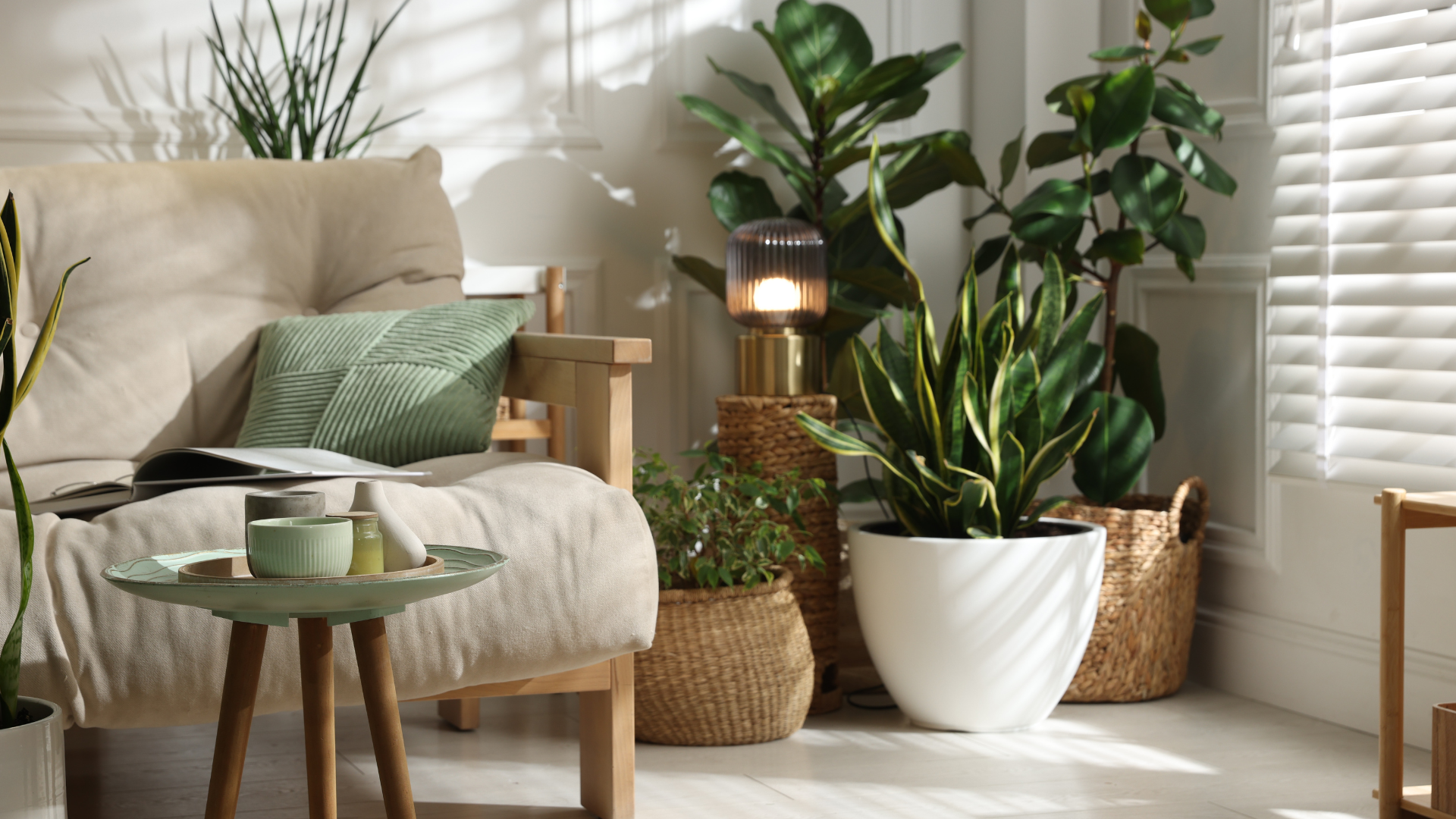
Natural light. Light exposure is one of the most powerful regulators of the human circadian rhythm. Research from the Lighting Research Center at Rensselaer Polytechnic Institute demonstrates that exposure to natural light during morning hours significantly improves sleep quality, mood stability, and alertness throughout the day. Insufficient light, particularly in winter months, is directly linked to dysregulated cortisol patterns and depressive symptoms. The application at home is simple: open the curtains. Sit by a window in the morning. Arrange the space where you spend the most time to receive the most light.
Greenery and nature contact. The biophilia hypothesis, first articulated by biologist E.O. Wilson and later expanded by environmental psychologists, describes the human nervous system’s innate orientation toward living things. Studies consistently show that even brief visual contact with plants reduces physiological stress indicators. A 2019 study published in Frontiers in Psychology found that spending just 20 minutes in a nature-rich environment was sufficient to meaningfully lower cortisol levels. You do not need a garden. Three houseplants placed near a window where you spend time may be enough.
Acoustic environment. Sound is one of the most underestimated stressors in the modern home. Chronic exposure to background noise, whether from televisions left on, street traffic, or the general auditory hum of a full household, keeps the sympathetic nervous system in a mild state of arousal. Research on hospital patients found that high ambient noise levels delayed healing times and increased reported pain. The inverse is also true: environments with low-level natural sound, specifically birdsong and flowing water, have been shown to activate the parasympathetic nervous system and support recovery. You do not have to silence your family. But consider: is there one space in your home designated for quiet?
Scent. The olfactory system has a direct neural pathway to the limbic system, the part of the brain responsible for emotional processing and stress response. This is why scent triggers memory and emotion so immediately, before the rational mind has a chance to process. Clinical aromatherapy research has demonstrated that lavender reduces salivary cortisol, improves sleep latency, and lowers anxiety scores in both clinical and community populations. Bergamot, frankincense, and clary sage each carry their own documented profiles. This is not indulgence. The nose is a portal to the nervous system, and you can use it intentionally.
Order and visual simplicity. A 2011 study at Princeton University Neuroscience Institute confirmed that visual clutter competes for cognitive resources, leaving the brain with less capacity for calm, focus, and emotional regulation. The presence of too many objects demanding attention creates a low-level cognitive load that is easy to overlook precisely because it never stops. This does not require minimalism. It requires intentionality. One cleared surface, one corner of order, can serve as a visual anchor for the nervous system.
The Theology of Place
The God we serve is not indifferent to our physical surroundings. Scripture is full of spaces set apart for restoration and encounter. The shepherd leads beside still waters. Elijah, depleted and undone, is met in the wilderness with food, water, and rest before God speaks to him. Jesus regularly withdrew to solitary places. He did not treat the need for restorative space as spiritual weakness. He modeled it.
First Corinthians 6:19 describes the body as the temple of the Holy Spirit. A temple is not simply a structure. It is a space prepared, ordered, and consecrated for a sacred purpose. If we take this seriously, the way we steward our physical environments is not separate from our faith. It is an expression of it.
You are not being self-indulgent when you light a candle and sit in a quiet room. You are not wasting time when you clear a surface so your eyes have somewhere to land that is not asking something of you. You are tending the temple. You are honoring the One who dwells there.
Where to Begin Without Overwhelming Yourself
This is not a renovation project. It is not a shopping list. It is a shift in attention.
Begin with a single sensory audit. Walk through your home slowly, one time, and ask: What is my nervous system receiving here? Not what needs to be done, not what you wish you had money to fix. What is your body actually taking in, in this space, right now?
Then choose one thing. One window to open in the morning. One drawer to clear. One candle with lavender or frankincense to light at the end of the day. One corner where you will sit without a screen for ten minutes.
The research is consistent: small environmental changes produce measurable physiological effects. You do not need to overhaul your home to begin healing in it.
What you need is to become intentional about the space you already have.
To Conclude
You have been managing your stress response inside an environment that may be adding to it, not relieving it. You have been trying to rest in spaces that were never set up for rest. And you have been doing this while taking care of everyone else, with whatever energy is left after the day is through.
You deserve a space that gives something back to you.
That is not luxury. That is stewardship. That is health. And it is available to you, not someday, not after the renovation, not when the kids are older. It is available in the next ten minutes, if you are willing to begin.
Be well.

+ show Comments
- Hide Comments
add a comment