



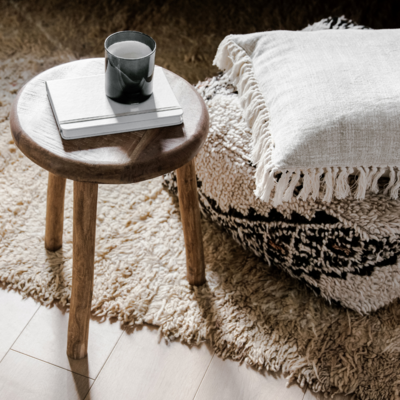




There is a room in your home that has one job.
It is not a second office. It is not a place to scroll through everything you didn’t finish today. It is not a staging area for the laundry pile or a holding room for the paperwork that followed you home. It was designed – by function, by purpose, by the rhythms God built into the human body – to be the place where you release the day and allow your nervous system to do what it was created to do.
Your bedroom is supposed to be a sanctuary.
For most women I know, it is anything but.
The average American adult sleeps 6.3 hours per night, according to the American Sleep Association. That is not rest. That is survival. And when women add a disorganized, overstimulating bedroom environment to an already dysregulated nervous system, they are essentially walking into a room that reinforces stress rather than signaling the body that it is safe to let go.
If you have been lying in bed and staring at the ceiling, waking at 3 a.m. with your mind still running, or dragging yourself out of bed in the morning without feeling restored, your environment may be working against your biology.
This is not a complicated problem. And it does not require a renovation budget.
It requires intention.
Why Your Environment Is Doing More Than You Think
The body responds to its surroundings whether you are paying attention or not.
When your brain receives visual cues of disorder, unfinished tasks, or stimulation, it begins producing cortisol – the stress hormone that signals it is time to mobilize, respond, and stay alert. This is the opposite of what sleep requires. Sleep requires the body to shift from the sympathetic state (fight or flight) into the parasympathetic state (rest and restore). That shift does not happen automatically in a chaotic environment. It has to be invited.
Environmental medicine researcher Roger Ulrich spent years studying the impact of physical environments on patient outcomes. His research consistently found that calm, natural, aesthetically ordered spaces reduced cortisol levels, lowered blood pressure, and shortened recovery times. His subjects were hospital patients. But the principle holds in your bedroom just as much as it does in a hospital room.
Your environment is a signal. The question is: what is yours saying?
The Elements of a True Rest Environment
Designing your bedroom as a sleep sanctuary does not mean it has to be sparse or styled like a high-end hotel (though there is nothing wrong with borrowing from that energy). It means every element in the room should be evaluated for one thing: does this support rest, or does it interrupt it?
Here are the core areas to address.
1. Light
Light is your body’s most powerful circadian cue.
Natural sunlight during the day keeps your cortisol appropriately elevated so that by evening, it can fall the way it should. But artificial light – particularly blue light from screens – suppresses melatonin production and tells your brain it is still daytime, even at 10 p.m.
Begin managing light at least 60 to 90 minutes before you want to sleep. That means:
- Dimming overhead lights and switching to warm, low-wattage lamps in the evening
- Removing screens from the bedroom or powering them down well before sleep
- Investing in blackout curtains or a quality sleep mask if your room receives outside light at night
- Considering amber-tinted bulbs or a salt lamp as your only evening light source in the bedroom
Light in the morning matters equally. When you wake to natural light – or to a sunrise alarm clock that mimics it – your circadian rhythm receives a clean signal, and the hormonal cascade for a healthy day begins on schedule.
2. Temperature
Your core body temperature naturally drops as part of the process of falling asleep. Researchers at the National Sleep Foundation identify the optimal sleep temperature range as 60 to 67 degrees Fahrenheit for most adults. When your room is too warm, your body cannot complete this process, and sleep quality decreases even when total hours remain the same.
This is one of the simplest, most effective interventions you can make. Lower your thermostat at night. Open a window if the air is cool. Consider lightweight, breathable bedding rather than heavy synthetic materials. A cooling mattress pad can also make a meaningful difference if your partner has different temperature preferences.
3. Sound
Silence is not always realistic. Families have children who wake in the night. Partners snore. Streets carry noise. The goal is not the absence of all sound – it is the absence of unpredictable, alerting sound.
The brain processes sound even during sleep and will rouse to something unfamiliar or irregular. Consistent, low-level sound, however – white noise, brown noise, soft rainfall, or gentle instrumental music – can create an auditory buffer that keeps the nervous system settled.
White noise machines, apps, or simple box fans are inexpensive and effective. If you have found that you wake easily at sounds in the night, an auditory buffer may be the missing piece.
Sound healing as a practice – particularly low-frequency sound like Tibetan singing bowls or delta-wave audio – has been studied in relation to autonomic nervous system regulation. Incorporating a brief sound healing practice before sleep as part of a wind-down routine can signal the brain that the day is complete.
4. Scent
The olfactory system is the only sense with a direct pathway to the limbic system, the emotional and memory center of the brain. This is why a particular scent can immediately shift your state.
Lavender is the most well-researched aromatherapy option for sleep. A 2015 study published in the Journal of Alternative and Complementary Medicine found that lavender aromatherapy significantly improved sleep quality in college students with self-reported sleep problems. Cedarwood, bergamot, vetiver, and Roman chamomile are also calming options.
A diffuser on your nightstand, a linen spray on your pillow, or even a drop of lavender on your wrist before bed can condition your brain to associate that scent with sleep – a form of intentional habit stacking that strengthens over time.
What you want to avoid: synthetic candles, plug-in air fresheners, or conventional fabric sprays. These often contain endocrine-disrupting chemicals that can quietly increase inflammation and hormonal disruption over time. Choose pure essential oils or natural botanical options.
5. Visual Order and Simplicity
Visual clutter is neurologically taxing.
Princeton University researchers published a study in the Journal of Neuroscience confirming that visual clutter limits the brain’s ability to focus and process information – and that this effect does not stop when you close your eyes. An overstimulating visual field before sleep keeps the brain in high-alert mode longer than it would otherwise remain.
This does not mean your bedroom must be minimalist to the point of feeling sterile. It means the visual environment should feel resolved. Put away what can be put away. Keep surfaces clear of work, unread mail, to-do lists, and anything that represents an incomplete task. Your brain knows what an unfinished pile of laundry means. Even when you are not consciously looking at it, it registers.
Consider: warm, natural materials (wood, linen, cotton), soft and muted color palettes, a few items that are genuinely meaningful and beautiful to you, and nothing that requires a decision or action.
6. The Technology Boundary
This one is not optional if rest is your goal.
Smartphones in the bedroom are associated with delayed sleep onset, lighter sleep stages, and more frequent nighttime waking. A 2018 study in JAMA Pediatrics found that for every hour of bedtime screen use, there was a statistically significant decrease in sleep quality and duration. The research trends are consistent across age groups.
The bedroom is for sleep and intimacy. That is the boundary.
If you use your phone as an alarm, consider replacing it with a simple alarm clock. Charge your phone outside the room. If this feels uncomfortable, that discomfort is worth paying attention to. The phone has become the first thing many of us reach for in the morning and the last thing we see at night. That pattern is not neutral – it is shaping your nervous system in ways that have nothing to do with rest.
Creating a Wind-Down Ritual
Designing the room is only part of the work. The other part is what you do when you enter it.
A sleep ritual is not a trend. It is a neurological signal. When you repeat a sequence of behaviors consistently before sleep, your brain begins to associate that sequence with the shift into rest. This is how sleep pressure builds – not just from being tired, but from being conditioned.
A simple, effective wind-down ritual might include:
60 minutes before bed: Dim all lights. Close out screens. Transition away from decision-making or stimulating conversation.
30 minutes before bed: A warm shower or bath (the subsequent drop in body temperature after exiting the water signals the brain that sleep is approaching), gentle stretching, reading something that nourishes and does not demand.
10 to 15 minutes before bed: A brief practice that settles the nervous system – slow, diaphragmatic breathing; a body scan; a few minutes of quiet prayer; or a short guided relaxation.
Final moments: Gratitude. A simple acknowledgment of what was good in the day. Research consistently links gratitude practice with improved sleep quality, likely because it shifts cognitive focus away from rumination and toward resolution.
A Word About What Rest Actually Requires
There is something deeper underneath all of this.
Many women I work with have created beautiful, intentional sleep environments – and still cannot rest. Not because the room is wrong, but because their nervous systems have been in chronic activation for so long that the body no longer recognizes the permission to stop.
If that is where you are, the environment matters. But the inner work matters more.
Rest is not just something that happens to your body when you lie down in the dark. It is something you have to allow. And allowing it requires believing – on some level – that you are worth caring for. That the work will still be there in the morning. That you do not have to earn your sleep. That your body is not a machine to be optimized. It is the dwelling place of something sacred.
Do you not know that your bodies are temples of the Holy Spirit, who is in you, whom you have received from God? -1 Corinthians 6:19
Your bedroom is not just a room. Tended with care, it becomes one of the most practical acts of stewardship in your home. It is where you restore the version of yourself your family, your work, and your faith need you to be.
Design it like it matters.
Because you do.

+ show Comments
- Hide Comments
add a comment